Today I woke up to an empty porch. No newspaper to cling to, no COVID stats to lean on to. No, I never go digital with my particular daily, as I need to hold it in my hands, and feel as if a prized possession has just landed into my hands. Only die-hard, hard-copy-newspaper fans would be able to relate to my fondness for the daily paper. With no newspaper to satiate my voracious appetite for reading, I got into my yoga session an hour earlier than usual.
Those who regularly practice yoga often tell me that in every session, there will be at least one asana (yoga posture) or a particular pranayama (yogic breathing technique), which one feels made a little more difference than the rest on a particular day. For me, today there were two such instances. One was with Yoga mudrasana, the other, with Bhramari pranayama.
Yoga mudrasana: I call it the “stretch-and-massage” asana. As the reader may see below, my mother’s spine is gently getting stretched in there, in turn toning her spinal nerves, and contributing towards a generally healthy disposition.

- Sitting in Padmasana, gently close your eyes, and relax.
- Keep breathing normally.
- Hold the right hand wrist behind the back using the left hand.
- Take a deep inhalation.
- While exhaling, bend forward, keeping the spine straight.
- Bring the forehead as close to the floor as possible.
- Relax the whole body in the final position.
- Remember not to strain the back, ankles, knees or thighs by forcing the body into posture.
- Slowly return to the starting posture.
- Repeat the practice again, this time the left wrist being held using the right hand.
- Practice 3 to 5 rounds everyday and know the difference.
Bhramari pranayama: Peaceful external surroundings are a pre-requisite for practicing Bhramari. Even though this pranayama can be practiced any time to de-stress, early morning is the best time as there are fewer external noises that interfere with internal perception. The vibrations produced in Bhramari have a great healing power, and often aid in post-operation recovery. Since the ears are the first line of contact in this pranayama, one should refrain from practicing this pranayama if one suspects an ear infection. Regular practitioners of Bhramari pranayama have reported better sleep and marked reduction in anxiety.
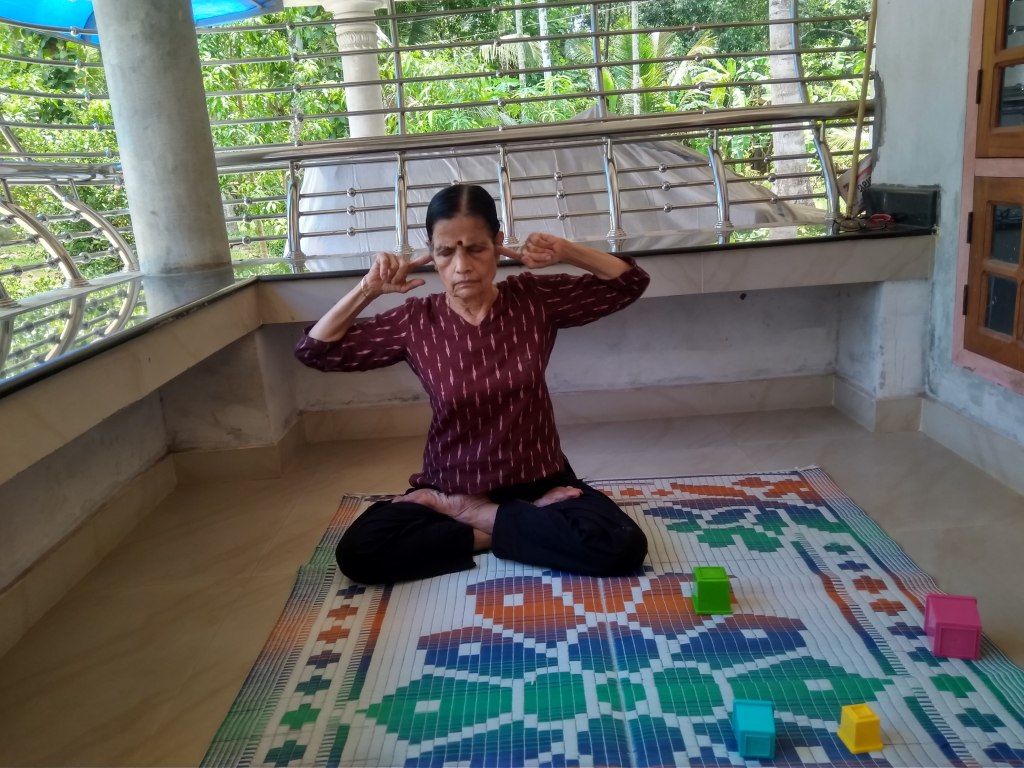
- Sit in padmasana or sukhasana. Would recommend sukhasana for beginners.
- Close your eyes and feel your entire body relaxing.
- Now, slowly relax your jaws.
- Ensure that your lips aren’t tightly pressed together, and are just gently closed.
- The upper and lower set of teeth should be slightly separated; imagine how much space you would leave if you were to allow a waft of air to pass between the upper and lower set of teeth.
- Raise your arms sideways, and bend the elbows, bringing the hands to the ears. Plug the ears using your index finger.
- Inhale through your nose.
- Exhale slowly, making a deep, steady sound like that of a humming bee.
- You will notice that the soft and mellow sound induces a kind of reverberation in front of your skull.
- This completes one round.
- Practice 3 to 5 such rounds every day.

 Write Left Right
Good writing chechi🤝👏
LikeLike